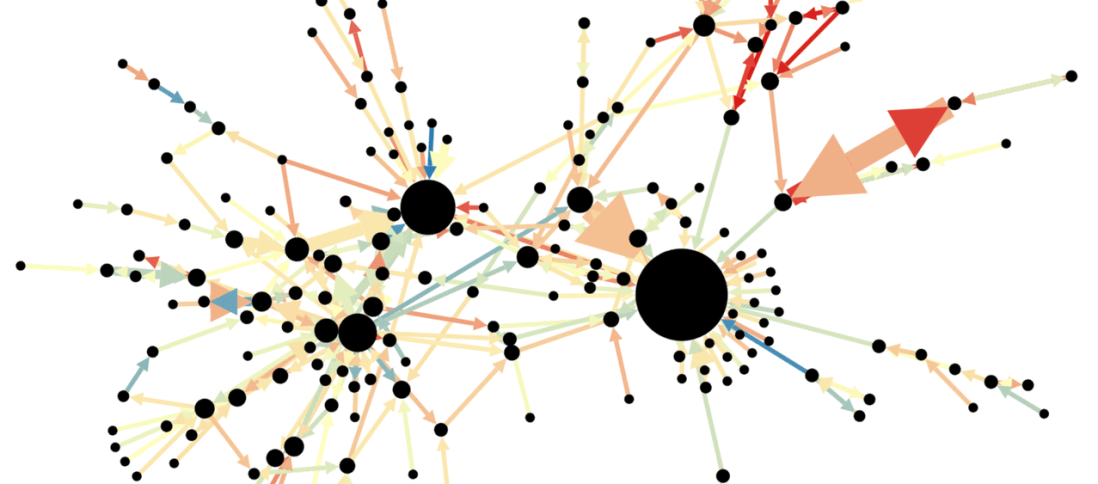
This paper concerns the role of online analytics in facilitating the rise of today's ubiquitous programmatic advertising, referred to herein as "AdTech." Most criticism of AdTech has focused on online tracking which captures user data, and digital advertising which exploits it for commercial purposes. Almost entirely lost in the discussion is the role of analytics platforms, which process personal data and make it actionable for targeted advertising. I argue that the role of analytics is key to the rise of AdTech, and has not been given the critical attention it deserves. I wrote this paper while pursuing my research as a PhD student at the University of Illinois School of Information Sciences. It has not been peer-reviewed or published elsewhere, and I’m posting it here to invite comments, criticism, and suggestions. Please feel free to send me email at jackb at illinois dot edu, or twitter message me @ jackbrighton.
Category: Search
Platformisation, by Thomas Poell, David Nieborg & José van Dick – Annotation & Notes
In this paper, published in the journal Internet Policy Review, the authors define and contextualize the concept of platformisation from four distinct scholarly perspectives: business studies, software studies research, critical political economy, and cultural studies. They suggest a research agenda making use of these four dimensions, so as to provide insight into “ever-evolving dynamics of platformisation” as sites of both benefits and harms to individuals and society. And they offer ways to operationalize the concept of platformisation in critical research on the emergence and concentration of power among a small number of platform companies, and how they are transforming social relationships and key societal sectors.
Annotation: Mining the Social Web
While mining the Information Science Virtual Library for academic papers on "social media" and "data mining," I came across Matthew Russell's O'Reilly book Mining the Social Web: Data Mining Facebook, Twitter, Linkedin, Google+, Github, and More. The 2nd edition was published in October 2013, with a 3rd edition scheduled for publication next month. Because the book covers the specific techniques I'm after concerning data mining and analysis of social media, I decided to pull the trigger and buy the book right now.
The book is basically a tutorial on data mining social media sites using Python. Alas all the source code it references is in Python 2.7 and I've been working with version 3.6, but that's fine. It also covers using IPython Notebooks and even begins with a guide to setting things up on a virtual server. I'll probably wait to actually do that until I see what's new in the 3rd edition. But the book definitely makes the final cut for my annotated bibliography. With that as a given, I thought it would be useful to get started with the first annotation.