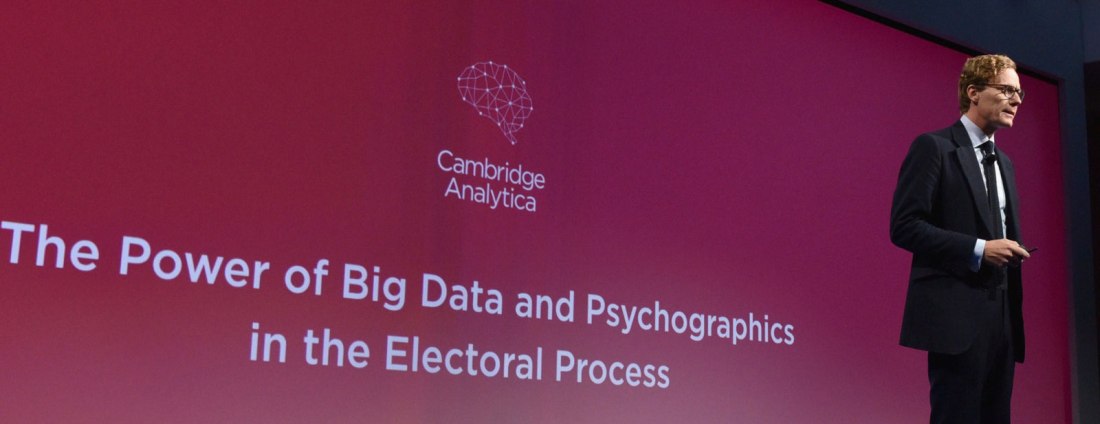
Annotation – Cambridge Analytica: Undercover Secrets of Trump’s Data Firm
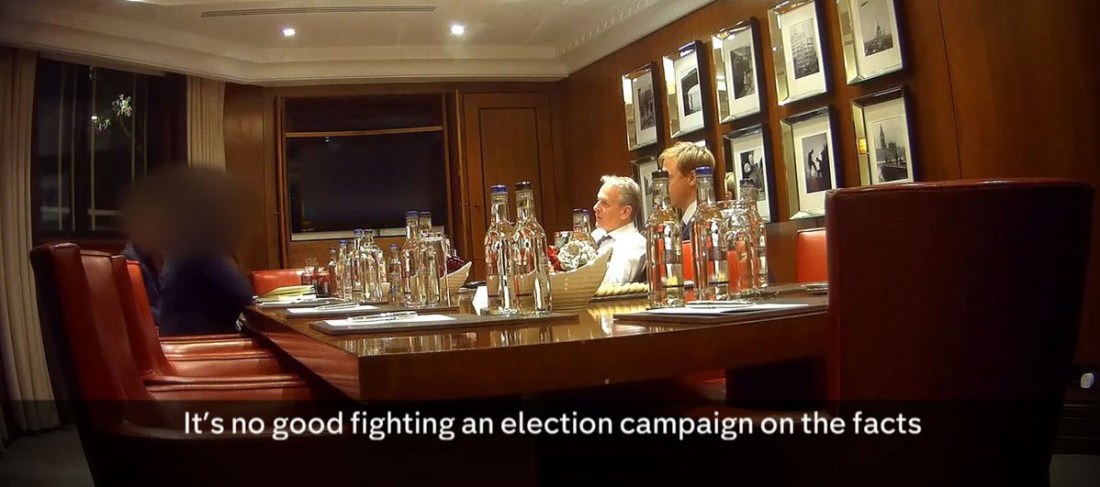
Cambridge Analytica staff saying it's no good winning an election on the facts

In the third and final part of their undercover investigation, Channel 4 News captures chief executives from Cambridge Analytica explaining how the firm used social media analytics to win the 2016 U.S. presidential election for Donald Trump. After this report was aired in March, Cambridge Analytica executives denied using social media analytics to win the election for Donald Trump. In earlier parts of this report, they claim to always tell the truth, while adding that actually people may not know or care what's true and what isn't. Anyway if people were misled it's not their fault. Also, these are not the 'driods you're looking for.

Annotation – Cambridge Analytica Uncovered: Secret filming reveals election tricks

Screenshot of video Cambridge Analytica Uncovered

The Cambridge Analytica story is what inspired me to pursue research on the details and methods of data processing that form the technical basis of using social media metadata for psychographic purposes, and the role of programming in accessing, collecting, processing, and using social media data, and the specific tools and workflow that enable this work. But I believe we can't fully understand the technical story without the political and social context. Technology isn't neutral, and our values are embedded in every tool we build. London's Channel 4 News discovered the values held by senior executives of Cambridge Analytica, as they detail in part two of their investigative report.

Annotation – Channel 4 News Report – Cambridge Analytica: Whistleblower reveals data grab of 50 million Facebook profiles

So far in this project I've been annotating traditional academic sources. These sources explore methods of machine learning, Natural Language Processing, sentiment analysis, and the tools used to mine social media for research purposes. But the literature hasn't kept pace with the news, and social media data is being used for things other than academic research. Like maybe stealing elections. Here begins a series of three annotations of investigative reports by London's Channel 4 News. These are video stories about Cambridge Analytica and its methods and role in political campaigns in the U.S., Africa, Europe and beyond. These are of course non-traditional annotations. But I consider the source credible, and given the subject important to include.

Annotation – Technology Firms Shape Political Communication: The Work of Microsoft, Facebook, Twitter, and Google With Campaigns During the 2016 U.S. Presidential Cycle

megaphone shouting social media icons

If you ran digital strategy for a presidential campaign, and Facebook came knocking on your door and said "We want to help you win this election," would you turn them down? There's nothing like a little help from the mothership.

Annotation: A 61-Million-Person Experiment in Social Influence and Political Mobilization

Sign saying spread the vote

Finally, a break from annotating technical stuff. Don't get me wrong I like it but...here's where it hits the road: Changes in voting behavior. Here we have a study published in 2012 in Nature on a randomized controlled study of changes in users voting behavior after seeing different versions of messages on Facebook. You want to read this one.

Annotation – Social Media Analysis – Challenges in Topic Discovery, Data Collection, and Data Preparation

Today's annotation summarizes an article published in late 2017 reporting on a systematic literature review of existing research on social media analytics. The authors seek to identify challenges that have not yet been solved by the models or the tools. I'll give you a hint at what they find: We are very good at looking for specific needles in the social media haystack, but not so good at finding the needles we're not looking for.

An Overabundance of Research, Data, and Tools

social network, communication in the global computer networks. silhouette of a human head with an interface icons

We've arrived at the inevitable point of imperfection. I started out looking for authoritative resources on how social media data is harvested, processed, and used in commercial and political communication campaigns, and I sure did find them. The problem is this realm is changing so fast, many of these sources are out of date. Regardless, this research project must come to an end on May 11th when I turn in my IS 452 final project. My proposed annotated bibliography has become a series of marginal blog posts. But the fight continues.

Annotation – Content Marketing Through Data Mining on Facebook Social Network

Gephi software visualization

So far I've been looking at how researchers analyze social media networks, and perform tasks like opinion or sentiment analysis to understand how people feel and think about various subjects and entities. With this annotation we're looking at a thing called content marketing, where influential users of a social network are first identified, then used to spread messages to their network of influence. Even in a huge network, a little bit of leverage in the right places can move products, and perhaps elections.

Annotation – Mining Social Media: Key Players, Sentiments, and Communities

VIKAMINE screenshot

This is an academic research project and for the most part I'm focusing on academic resources. But I'm working to understand the specific tools and methods for mining social media data in order to effectively intervene using communications campaigns. The annotation offered here adds to these concepts by introducing "community mining" and techniques for analyzing key players, roles, and strong subgroup connections of communication and influence within a larger social media network. These are key concepts for understanding how opinions within a network are formed, shared, and spread. Or as someone might have once said, it's about influencing a group by influencing the influencers.

Annotation – Comparative Opinion Mining: A Review

Thumbs up down and sideways

I had no sense of how much research has been done on sentiment analysis, opinion mining, and machine learning. I suppose major progress had to wait until there were massive datasets of text content available to process. The explosion of data on social media has provided both the impetus and the fodder to develop increasingly sophisticated techniques that are beginning to actually work. In this annotation I present an overview of the techniques and tools of comparative opinion mining. It's great to know what people feel and think about one thing. It's probably twice as great to know what they think about two things. Like two different cars, guitars, or political candidates.