Parasitic Platforms and the Crisis in News

The boarded-up building of the McKeesport Daily News near Philadelphia

The viability of news has been in rapid decline since the mid-2000s. This post presents a critical analysis of how news publishers themselves helped precipitate the crisis by enthusiastically adopting Big Tech platform technologies and audience-building strategies. I show how search and social media platforms disrupted publishers’ relationships with audiences and advertisers by appropriating control over news distribution and revenue. I use Anthony Giddens’ structuration theory and Bruno Latour’s actor-network theory to explore the restructuring of the news industry by the sociotechnical practices and surveillance economics of today’s dominating platforms. Leveraging Michel Serres’ discourse on social parasitism, I present a research framework for assessing symbiotic and parasitic relationships in sociotechnical systems using historical, quantitative, and qualitative methods, and to identify where news publishers still have agency to begin resolving the crisis. And I suggest the urgency of this research framework as publishers rapidly adopt new AI technologies.

Decolonial AI: Decolonial Theory as Sociotechnical Foresight in Artificial Intelligence – Annotation & Notes

This paper looks at advances in artificial intelligence through the lens of critical science, post-colonial, and decolonial theory. The authors acknowledge the positive potential for AI technologies, but use this paper to highlight its considerable risks, especially for vulnerable populations. They call for a proactive approach to be adopted by AI communities using decolonial theories that use historical hindsight to identify patterns of power that remain relevant – perhaps more than ever – in the rapid advance of AI technologies. 

Critical data modeling and the basic representation model – Annotation & Notes

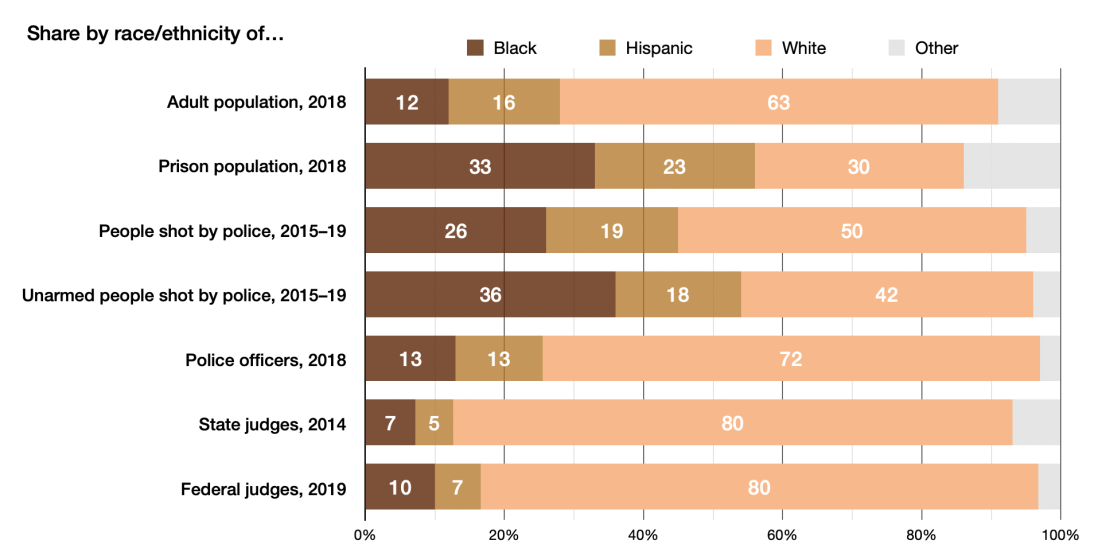
Chart showing Race disparities in US criminal justice system, late 2010s

Data models are foundational to information processing, and in the digital world they stand in for the real world. When machines are used to make algorithmically-informed decisions, their algorithms are informed by the data models they use. And the data structured by data models is numerical of necessity, since machines must perform logical operations, and not creative interpretations. It follows that data used in machine operations are machine-language translations of real-world phenomena, expressed in a data model designed for efficient processing. It should not be surprising then that as information systems increasingly make decisions that affect people and communities, their operations are in a very direct sense an extension of the messy human world. This has resulted in information systems that reflect human racism, sexism, and many otherisms, with real-world harm to individuals and communities. But given the black-box nature of “machine learning” algorithms, how do we know what happens inside the black box? How can we document machine bias so as to design algorithms that don’t perpetuate social harms?

The Application of Artificial Intelligence to Journalism: An Analysis of Academic Production – Annotation & Notes

This paper presents a summary of academic research on AI use in journalism, based on the authors’ review of 358 texts published between 2010 and January 2021. The materials they reviewed were found through academic databases including Scopus and Web of Science, in addition to Google Scholar. Most of the articles were published in English, and the majority was from the United States. Given significant developments with AI, and AI in journalism, since 2021, this paper is really a snapshot of research published for the period covered. The authors do note a rapid increase in research until 2019, with a dropoff in 2020 presumably from disruptions of the COVID-19 pandemic.

Newsrooms and the Disruption of the Internet: A Short History of Disruptive Technologies, 1990–2010 – Annotation & Notes

A view of news on a computer, a tablet, and a smart phone

This book is a detailed account of how news organizations in the U.S. and U.K responded to society-wide changes brought by internet technologies and the World Wide Web. The account is informative in many ways, recounting key events year-by-year and the discourse by news professionals and executives. Not surprisingly, the gist is that they couldn’t predict the future, responded the best they could, got some things right and some things wrong.