Decolonial AI: Decolonial Theory as Sociotechnical Foresight in Artificial Intelligence – Annotation & Notes

This paper looks at advances in artificial intelligence through the lens of critical science, post-colonial, and decolonial theory. The authors acknowledge the positive potential for AI technologies, but use this paper to highlight its considerable risks, especially for vulnerable populations. They call for a proactive approach to be adopted by AI communities using decolonial theories that use historical hindsight to identify patterns of power that remain relevant – perhaps more than ever – in the rapid advance of AI technologies. 

Critical data modeling and the basic representation model – Annotation & Notes

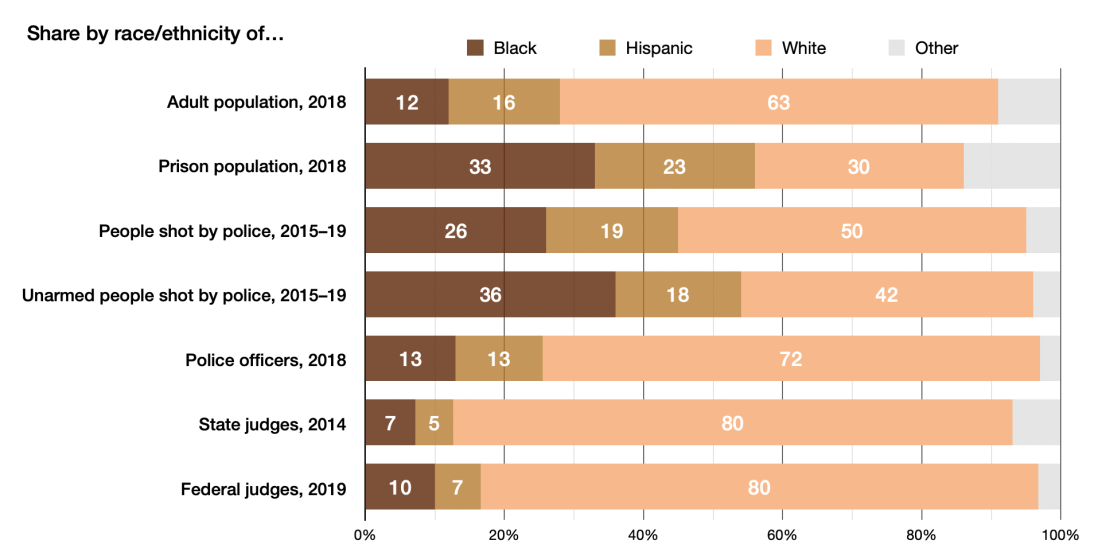
Chart showing Race disparities in US criminal justice system, late 2010s

Data models are foundational to information processing, and in the digital world they stand in for the real world. When machines are used to make algorithmically-informed decisions, their algorithms are informed by the data models they use. And the data structured by data models is numerical of necessity, since machines must perform logical operations, and not creative interpretations. It follows that data used in machine operations are machine-language translations of real-world phenomena, expressed in a data model designed for efficient processing. It should not be surprising then that as information systems increasingly make decisions that affect people and communities, their operations are in a very direct sense an extension of the messy human world. This has resulted in information systems that reflect human racism, sexism, and many otherisms, with real-world harm to individuals and communities. But given the black-box nature of “machine learning” algorithms, how do we know what happens inside the black box? How can we document machine bias so as to design algorithms that don’t perpetuate social harms?

Information and Communication Technology and Society – Annotation & Notes

In this article Fuchs introduces “Critical Internet Theory” as a foundation for analyzing the Internet and society based on a Marxian critique. He illustrates Critical Internet Theory (hereinafter CIT for brevity) using the emergence of the so-called Web 2.0 as an Internet gift commodity strategy, wherein users produce content on free platforms, which commodify the content to increase their advertising revenues. Fuchs introduces the concept of the “Internet prosumer commodity” to describe this “free” exchange of labor and value. This strategy, he writes, “functions as a legitimizing ideology.”

The Application of Artificial Intelligence to Journalism: An Analysis of Academic Production – Annotation & Notes

This paper presents a summary of academic research on AI use in journalism, based on the authors’ review of 358 texts published between 2010 and January 2021. The materials they reviewed were found through academic databases including Scopus and Web of Science, in addition to Google Scholar. Most of the articles were published in English, and the majority was from the United States. Given significant developments with AI, and AI in journalism, since 2021, this paper is really a snapshot of research published for the period covered. The authors do note a rapid increase in research until 2019, with a dropoff in 2020 presumably from disruptions of the COVID-19 pandemic.

Dealing with Digital Intermediaries: A Case Study of the Relations between Publishers and Platforms – Annotation & Notes

In this article, published in 2017 in the journal New Media & Society, Nielsen and Ganter report on a series of interviews with editors, senior management, and product developers at a large, well-established European news media organization regarding their experiences and perspective on relationships with the main digital platforms that are now central to news distribution, namely Facebook and Google. This paper documents the asymmetrical power relationship between a large, well-known and successful news organization, and the digital platforms on which it now depends for audience reach. And it points to a gap in similar research on smaller, more precarious news organizations. 

Period, Theme Event: Locating Information History in History

When we focus primarily on innovations in information technology, we risk flirting with technological determinism while forgetting about the social context. The question for information historians is not “how did this information technology come about,” but “how can we explore history by examining social practices around information and its infrastructures.” But this question is so general it doesn’t provide much of an entry point for actual research. To address the problem of “where do we start,” Alistair Black and Bonnie Mak (2020) propose three specific lenses as an organizing paradigm: Period, Theme, and Event.

Platformisation, by Thomas Poell, David Nieborg & José van Dick – Annotation & Notes

In this paper, published in the journal Internet Policy Review, the authors define and contextualize the concept of platformisation from four distinct scholarly perspectives: business studies, software studies research, critical political economy, and cultural studies. They suggest a research agenda making use of these four dimensions, so as to provide insight into “ever-evolving dynamics of platformisation” as sites of both benefits and harms to individuals and society. And they offer ways to operationalize the concept of platformisation in critical research on the emergence and concentration of power among a small number of platform companies, and how they are transforming social relationships and key societal sectors. 

Reshaping the public radio newsroom for the digital future, by Nikki Usher – Annotation

NPR logo on the side of the NPR buiilding

Published in 2012 based on field research conducted by Nikki Usher from 2008 to 2010, this paper presents an account of NPR’s response to a rapidly changing digital media environment. As audiences increasingly looked to the web for news, management at NPR understood a need for fundamental change in its operations and identity, from an organization focused entirely on news production for radio broadcast, to a digital media company producing multimedia for online distribution along with traditional NPR broadcast content. 

Autoethnography: An Overview – Annotation & Notes

It seems appropriate to use my first-person voice in this annotation. But let’s begin with the authors’ voice for context: “Autoethnography is an approach to research and writing that seeks to describe and systematically analyze (graphy) personal experience (auto) in order to understand cultural experience (ethno)” (p.273).

When search engines stopped being human: menu interfaces and the rise of the ideological nature of algorithmic search – Annotation & Notes

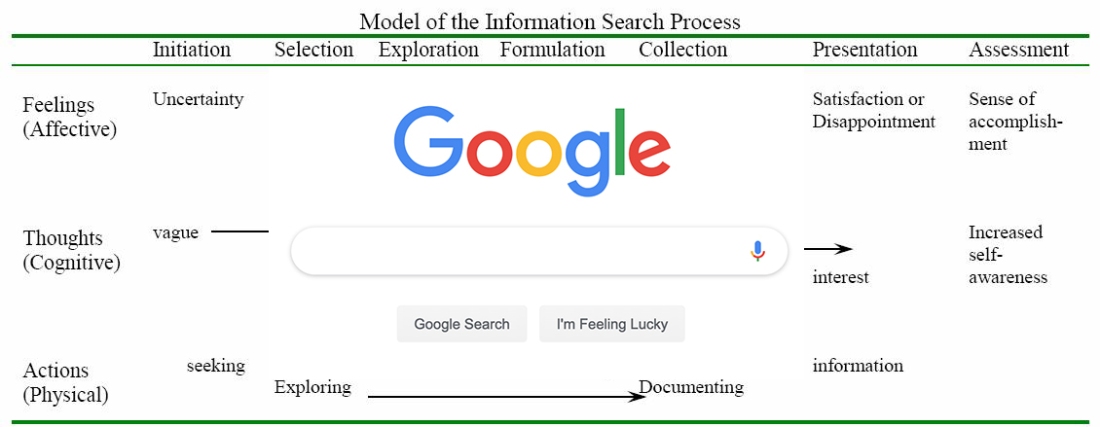
Carol Kuhlthau’s Information Search Process with Google Search superimposed

In recent years, some have argued that if you can’t find information on Google, it might as well not exist. This assertion is problematic given that according to various estimates, the scope of Google’s search index range from 4 percent to .004 percent of the total Internet. Neils Kerssens examines these questions in the context of “positivist algorithmic ideology,” a normalizing force that frames certain practices as an established standard exempt from further interrogation.